Friday, December 2, 2016

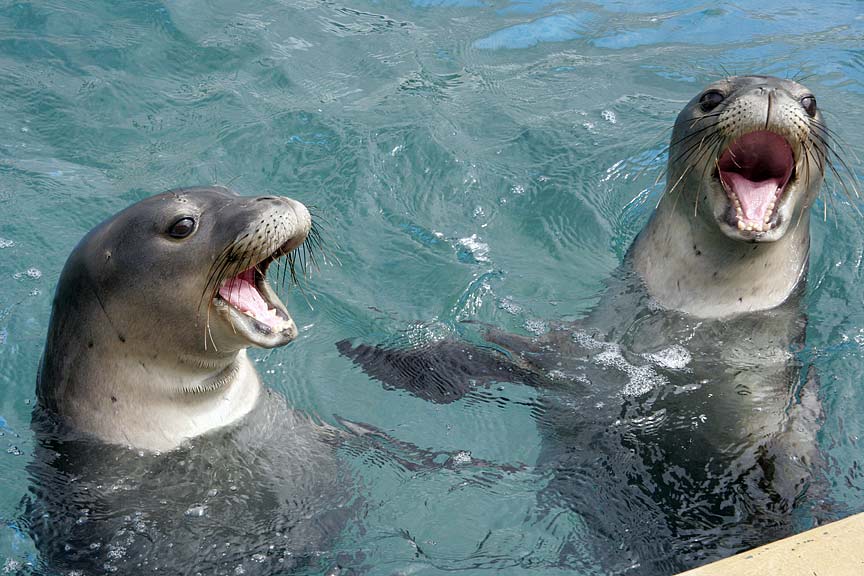
Hawaiian Monk Seal by Javier Suarez


Glossary
EEZ: Exclusive Economic Zone
NWHI: Northwestern Hawaiian Islands
MHI: Main Hawaiian Islands
NMFS: National Marine Fisheries Service
TMMC: The Marine Mammal Center
FWS: Fish & Wildlife Service


Description and Ecology 
While most species of seals enjoy the frigid nature of colder waters, the Hawaiian Monk seal finds its peace in the tropical weathered waters of the Northwestern Hawaiian Islands as well as some of the Main Hawaiian Islands. These playful but powerful marine mammals are one of the few seal species that inhabit tropical and subtropical waters. The only other two species are the Mediterranean Monk Seal which is critically endangered, and the extinct Caribbean Monk seal. Hawaiian Monk seals can weigh as much as 375-450 pounds, and reach up to 7-7.5 feet in length with females being notably larger than males. Furthermore, they can to live up to 30 years, and mothers are also known for giving close care to their pups during their nursing period (TMMC).

Geographic and Population Changes
The Hawaiian Monk Seals’ range is almost entirely exclusive to the United States’ EEZ, and is divided into six sub populations located in the Northwestern Hawaiian Islands:
  1. Kure Atoll
  2. Midway Islands
  3. Pearl and Hermes Reef
  4. Lisianski Island
  5. Laysan Island
  6. French Frigate Shoals
More recently, a new population also began appearing and breeding on most of the Main Hawaiian Islands. The earliest sighting recorded in the MHI is from 1912 in Hilo Bay, where the individual was killed and then eaten by the local islanders. No systematic surveys had been taken to measure the population in the MHI until 2000, where areal and ground surveys counted at least 45 individuals. One year later 52 were counted, and a 2007 survey revealed a population of around 77. However, these surveys are known to be “well below total abundance” as they cannot account for all the individuals in the water (FWS).

Listing
Also referred to as: "llio hollo I ka uaua," meaning "dog that runs in rough water." This majestic species was hunted to near extinction in the latter part of the 19th century and listed as endangered on 11/23/1976 by the U.S. Fish and Wildlife Service (FWS).


Is This The End? (Main Threats)
Although the scientific community has been making great efforts to study and protect monk seals in Hawaii, the metapopulation in the NWHI has been constantly declining for the last 20 years. Luckily, because there has been an extensive amount of research done on monk seals, the main threats to this rare sub species of seals are clear and already being managed in a way or another. However, while these efforts have helped mitigate the damage, they have not completely obliterated these threats as the trends still show a clear decline in the seal sub-populations (FWS).
By far the most threatening issue is the low rate of survival of juvenile seals, due both to starvation of pups and sub-adults as well as predation by Galapagos Sharks. Other still very menacing issues are:
  • Entanglement in marine debris.
  • Human interaction and disturbances/exposure to disease.
  • Habitat loss.


Is there Hope? (Recovery Plan)
Indeed, there is! Although the recovery time is not predictable with the current data, the case for Hawaiian Monk seals presents the best hope for the conservation of the tropical and subtropical seal species. The main goal for the recovery plans is to aid the female juvenile population through a captive care program to “nutritionally supplement” them. This will then combat the main threat which is starvation. Other actions will include removing marine debris and protecting females from shark and male aggression. Finally, research will focus on “better understanding the factors that result in poor juvenile survival.” This will be carried out through a base 5-year plan which has a cost of $35,915,000 (FWS).

What Can You Do?
Luckily there is a plethora of tasks available for the public to help with. Volunteers are an integral part of operations of this scale, and various recognized organizations such as The Marine Mammal Center offer volunteering opportunities in a great variety of programs.
You can get started by visiting their website to find more about what they have to offer at: http://www.marinemammalcenter.org/Get-Involved/volunteer/
Don’t have the time to volunteer but still want to help? You can still be of great help by donating to their cause!

Other Resources!
Want to find more about Hawaiian Monk Seals?
A full copy of their recovery plan is available at:
Don’t feel like reading a 165-page document? Then check out this short article by the MMC:

Works Cited
"The Marine Mammal Center." The Marine Mammal Center. N.p., n.d. Web. 01 Dec. 2016.
"Parturition In The Hawaiian Monk Seal (Monachus Schauinslandi)." Marine Mammal Science6.2 (1990): 146-51. Web.


San Joaquin Kit Fox--Cassandra Sanchez


What can we do to save the San Joaquin Umbrella Species?

Our progression is leading to the depression of the San Joaquin Kit Fox.

By Cassandra Sanchez
http://esrp.csustan.edu/speciesprofiles/profile.php?sp=

The smallest, carnivorous fox in North America, the San Joaquin Kit fox (Vulpes macrotis mutica), was listed as endangered on March 1967 but the recovery plan of the Kit Fox was posted in 1998. They were listed as endangered due their lack of range in the southern San Joaquin Valley and surrounding foothills. Male Kit Foxes are typically 32 inches in length and weigh about 5lbs. Females are a bit smaller than the males and breed only once a year and constantly move habitats which are their underground dens. The Kit foxes are coated with beautiful grey fur in the winter and tan coats in the summer. They feed off of kangaroo rats, pocket mice, rabbits, reptiles, berries, and insects and are prey to coyotes, eagles, and bobcats. The possible extinction of these Kit Foxes could potentially pose a major threat to other animals due to the fact that they are an umbrella species and a keystone species—animals identified as umbrella species protect many habitat types and the species that inhabit those areas and animals identified as a keystone species are species that other species in an ecosystem largely depend on. If that species were to be removed from the ecosystem, the ecosystem would be negatively altered.

  Since the nocturnal San Joaquin Kit Fox is an umbrella species and a keystone species, it is an interim goal that they are delisted from endangered to threatened. Not that it isn’t important for the species to recover if they weren’t an umbrella species, but the recovery of the San Joaquin Kit Fox is of primary importance than other species in the San Joaquin Valley because it is more difficult to recover the kit foxes, but “fulfilling the fox’s needs also meets those of many other species” (ecos.fws.org) as well. The San Joaquin kit fox inhabited California’s San Joaquin Valley before 1930. The populations of Kit foxes extended from southern Kern County to eastern Contra Costa County By 1930 its range may have been reduced to half, mostly in the southern and western San Joaquin Valley and foothills.  The San Joaquin kit fox currently resides in "highly fragmented landscape of scattered remnants of native habitat". (epa.gov) These little creatures used to inhabit part of my home, but due to the building of new roads and cities, their homes are being destroyed for the development of my home of Bakersfield in particular. Not only are the roads an issue, but the roads allow for animals to be accidently ran over and killed as well. The highest threats posed to the critters are agricultural conversion, infrastructure construction, and urban development. Also, the siting of solar facilities in kit fox core, satellite, and linkage areas (areas of separated populations of Kit Foxes) poses a threat as well and could affect the populations of the Kit Fox.


The plan to recover this umbrella species utilizes a ecosystem approach due to the dominance of humans in the San Joaquin valley, especially Bakersfield which is my hometown. The city of Bakersfield has been planning to create artificial dens to provide long term benefits toward the increase of the Kit Fox population. Basically, the primary action taken right now is to conserve the remaining habitats of the kit foxes and reunite the other populations together because habitat fragmentation is contributing to the decrease in individual populations. The San Joaquin Valley as a whole has created several canal "right-of-ways" that serve as travel corridors between northern and central occurrences of the species along either side of the canal. The natural lands in canal right-of-ways have provided relatively abundant passageways.


Now, what could we do?
The California Department of Fish and Wildlife provided us with helpful tips to help contribute to the protection of these critters:


  • Never feed a kit fox or other wildlife; keep pet food indoors.
  • Remove sources of water.
  • Seal trash containers to prevent access.
  • Put away bird feeders at night to avoid attracting rodents and other prey.
  • Pick up fallen fruit and cover compost piles.
  • Don't trap stray cats in areas used by kit foxes. Trapped foxes could get injured and their pups are vulnerable when unattended.
  • Never fill or destroy a burrow that may be used by kit foxes. State and federal laws protect their burrows.
  • Take down sports nets at schools, parks and other recreational facilities when not in use. Store furled and out of reach, especially at night.
  • Avoid the use of rodent poisons in kit fox habitat.
Additional Resources--
Here is a printable pdf brochure from Keepmewild.org on how to help increase the fitness of our San Joaquin Kit Foxes:


THANK YOU FOR READING!


Works Cited
“Innovative Approach to the Recovery of the San Joaquin Kit Fox.” Innovative Approach to the Recovery of the San Joaquin Kit Fox,                       http://www.icoet.net/ICOET_2013/documents/papers/ICOET2013_Paper211D_Gray.pdf. Accessed 22 Nov 2016.

“San Joaquin Valley Fever.” SpringerReference, http://ecos.fws.gov/docs/five_year_review/doc3222.pdf. Accessed 22 Nov 2016.

"Recovery Plan." SpringerReference, http://ecos.fws.gov/docs/recovery_plan/980930a.pdf. Accessed 22 Nov 2016

"Licenses and Permits."Licenses and Permits, https://www.wildlife.ca.gov/Licensing. Accessed 29 Nov 2016.

"Endangered Species Facts". EPA, https://www.epa.gov/sites/production/files/2013-08/documents/san-joaquin-kitfox.pdf. Accessed 2 Dec 2016.


Desert Tortoise -Noah Simpson

The Local Legend of the Southwest Desert Scene

The slow and steady desert tortoise way won't suffice for their conservationist friends.

Noah Simpson

1 December, 2016


Contained mostly to the Mojave and Sonoran deserts in the southwest corner of the United States and into northern Mexico, the desert tortoise or scientifically known as the gopherus agassizii, is a large, herbivorous reptile. The species can grow to be anywhere from 8 to 15 inches in length and 4 to 6 inches in height, as well as weigh 8 to 15 pounds. The unique species sets itself apart from many desert animals with its domed outer shell on top and flat bottom shell that encases the tortoise.
(http://ecos.fws.gov/docs/species_images/doc3729.jpg
Its stumpy hind legs and tail have a dry skin while heavy, scaly skin covers its front legs for digging. The simplicity of the desert tortoise is offset with unexpected abilities like burrowing underground or swimming in shallow ponds.


Much of the health of desert tortoises is at the mercy of the harsh  environments in which they live. The health, reproductive patterns, and behavior of these animals are very much dependent on their surroundings; variables such as temperatures, plant life, and water availability are huge in deciding the prosperity of the species. The desert tortoise’s incredible ability to conserve water and energy allow the animal to survive the extreme desert conditions.

While the desert tortoise has populations throughout southwestern United States and into the northern part of Mexico, certain critical habitats are the focal points of the recovery process.

(http://ecos.fws.gov/docs/recovery_plan/RRP%20for%20the%20Mojave%20Desert%20Tortoise%20-%20May%202011_1.pdf)


As shown in the image above, federal lands in southwestern Utah, northwestern Arizona, southern Nevada, and southern California have been designated are the main areas for improving desert tortoise populations. Nearly 2 million of the total 2.6 million hectares of critical land is located in California.

Population and density estimates for desert tortoises are difficult to accurately conduct due to the species unique development and behaviors. The slow moving, low-ground species that can look like a rock and burrows itself underground for months on end is rather elusive. Monitoring the effectiveness of recovery projects is also made difficult by the 13 to 20 year maturity time that a desert tortoise must live before able to yield offspring. 

Over a six year monitoring span (2001-2005, 2007), desert tortoises were least abundant in the Northwest Mojave Recovery Unit with an estimate of 2-10 individuals per square mile; the species was found most abundantly in the Upper Virgin River Recovery Unit with a range of 38-69 tortoises per square mile.

A population of desert tortoises on the Beaver Dam Slope in Utah was the first to be identified as Threatened by the United States Fish and Wildlife Service under the Endangered Species Act of 1973. In the following years greater populations were added to the protections list and eventually the species’ first recovery plan was published in 1994. Human interference and loss of habitat are the main causes for the species’ struggles. As man-made structures and transportation ways expand into the desert environment, the availability of safe burrowing and breeding grounds decrease. Other threats to the desert tortoise include: the killing and collecting of tortoises by humans, diseases created by toxic environmental contaminants, predation of hatchlings and juveniles by the common raven, lack of funding for enforcing habitat regulations, as well as global climate change and drought.

Over the last twenty years, researchers and conservation groups have been working to pinpoint the reasons for the loss of populations and the most effective ways to combat these problems. A broad six step recovery strategy outlines the basics for improving desert tortoise populations:

  1. Develop, support, and build partnerships to facilitate recovery.
  2. Protect existing populations and habitat, instituting habitat restoration where necessary.
  3. Augment depleted populations in a strategic manner.
  4. Monitor progress toward recovery.
  5. Conduct applied research and modeling in support of recovery efforts within a strategic framework.
  6. Implement a formal adaptive management program.

The professional rhetoric of the U.S. Fish and Wildlife Service can be confusing at times, so they have also included real life examples for understanding their conservation efforts. Acquiring critical habitat land by conservation groups, installing protective fencing, improving grazing management, and limiting off-road vehicle access are some applied projects to the recovery movement. The continued practice and development of these recovery methods look to achieve the goal of the recovering and delisting of the desert tortoise, a goal that is expected to be met by 2025.

Getting involved can be as easy as becoming informed and aware of the current issue. Watching a quick YouTube video on the magnificent species and sharing it with your Facebook friends can effectively get the message across to many people that may not know of the desert tortoises’ decline. Being vocal with your social media is a good start, but sharing your passion for the species with your government leaders can improve the discussion within the political sphere. Adopting a tortoise is another way to help out; through the Defenders of the Wildlife program, a small donation can assist in the great work that conservationists do everyday. Plus, this option comes with a cute plush desert tortoise!
(https://secure.defenders.org/ac/img/adoptions/plushes/large/desert-tortoise-wild584-IMG_4437.jpg)

For additional information on way to get involved, check out the Defenders of the Wildlife’s website.
For more general information on the desert tortoise, the U.S. Fish and Wildlife Service and Defenders of Wildlife both have websites providing a more in depth look into the species.


Works Cited:
"Adopt a Desert Tortoise." Adopt a Desert Tortoise - Wildlife Adoption and Gift Center. Defenders of Wildlife, n.d. Web. 01 Dec. 2016.

"Basic Facts About Desert Tortoises." Defenders of Wildlife. Defenders of Wildlife, 10 Apr. 2014.                          Web. 01 Dec. 2016.

Revised Recovery Plan for the Mojave Population of the Desert Tortoise (Gopherus Agassizii).        Sacramento, CA: U.S. Fish and Wildlife Service, Pacific Southwest Region, Division of Listing, Recovery and Environmental Contaminants, 2011. Department of the Interior. Web. 01 Dec. 2016.

Service, U.S. Fish and Wildlife. "Species Profile for Desert Tortoise (Gopherus Agassizii)." Species Profile for Desert Tortoise (Gopherus Agassizii). Department of the Interior, n.d. Web. 01 Dec. 2016.

"What You Can Do to Help Desert Tortoises." Defenders of Wildlife. Defenders of Wildlife, 19 Oct. 2016. Web. 01 Dec. 2016.